Home › Rat Control
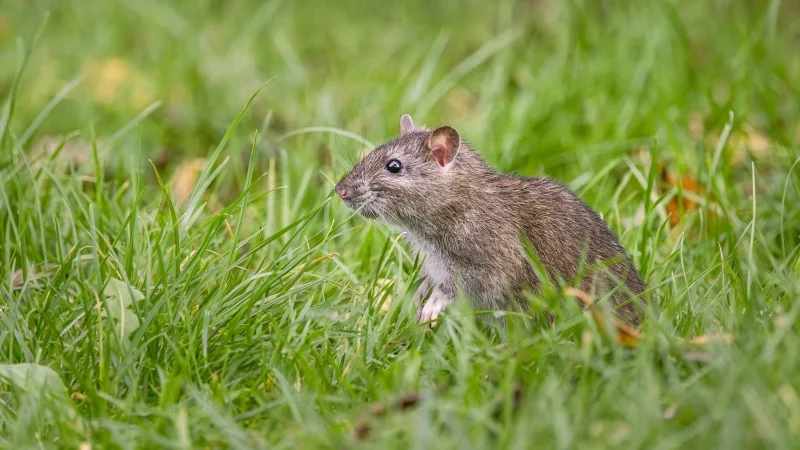
Buffalo's rat is the Norway rat. It lives in burrows along foundations, under porches and sheds, and along the sewer lines and creek banks that run through most neighborhoods. Roof rats are not established in New York, so if you are seeing rats here, this is the one you have, and it behaves in predictable ways once you know what to look for.
Rat calls in Buffalo have a pattern. A homeowner sees one rat in the yard in daylight, which usually means the burrow system is crowded enough that lower-ranking animals are being pushed out to feed at odd hours. Or the dog starts digging at one corner of the fence. Or the neighbor two doors down mentions the same thing, because a rat problem on a Buffalo street is rarely one house's problem.
Cheektowaga's rat trouble has been in the local news for years, with town records going back two decades, and Kenmore residents have filled neighborhood pages with sightings. If your street is dealing with it, you are not imagining the scale of it.
We start outside, because that is where Norway rats live even when they feed inside. The inspection maps burrows, runways and food sources, then checks the house for entry at ground level, at the sewer lateral and around utility lines.
Control combines trapping, tamper-resistant bait stations on the exterior where they are appropriate, and burrow treatment. Inside, if rats have reached the basement or walls, trapping comes first. Poison inside a structure is a last resort for a simple reason. A dead rat in a wall is a removal call and two weeks of smell.
The step most services skip is the food and harborage cleanup list. Bird feeders over the burrow system, dog droppings left in the yard, an open compost pile and a woodpile against the foundation will defeat a good trapping program. We will point at the specific things on your property and tell you which ones matter most.
A lot of Buffalo rat activity tracks the infrastructure. Older combined sewers, cracked laterals and creek corridors like Scajaquada and Cazenovia give rats protected routes under whole neighborhoods. Construction that disturbs a sewer line can push a colony into yards that never had rats before, which is exactly what Cheektowaga homeowners described after road work on their street.
That is also where the county fits in. Erie County will bait qualifying properties and take complaints about problem sites, and our county program guide explains what it covers. What it does not do is work inside your house, seal your foundation, or run a monitored program for a business. That part is ours.
Once the population is down, exclusion keeps it down. Burrow entries at the foundation get packed and sealed, gaps around pipes get steel and sealant, and broken vent covers and cellar windows get replaced with rodent-proof material. Pair that with garbage in cans with tight lids, which Buffalo requires anyway, and the street becomes a much harder place for a rat colony to rebuild.
Rat control is for the homeowner whose problem lives outside first: burrows along the foundation, rats in the yard at dusk, a dog that will not leave one fence corner alone. It is for streets where two or three houses are seeing the same thing, which in Buffalo usually means a sewer line, a creek bank or a food source is feeding the whole block. And it is for the smaller group who find rat signs inside, in a basement or a wall, where the work becomes urgent in a way yard work is not.
If your rat sightings are in a business, a rental building or a food operation, the same program runs under the commercial service, with the documentation those settings need. If you are not sure whether what you are seeing is rats at all, the inspection answers that first, because vole runs and squirrel activity both get reported as rats every spring.
Rat programs are priced from the burrow and food map, not from a flat call-out number. The size of the burrow system is the biggest factor: two holes at one foundation corner is a different job from a system running under a porch, a shed and a fence line. Exterior stations, where they fit, are priced by how many the property needs and how often they are checked. Burrow treatment and the sealing of foundation entries are separate pieces, and a house with rats inside adds trapping and possibly cleanup on top of the yard work.
Market ranges for Buffalo rat work and the rest of the local pricing picture are on the cost page. One honest warning belongs here: a quote for rat control given over the phone without anyone walking the property is not a quote. Nobody can see a burrow system from a desk.
We can treat your burrows, station your property, seal your foundation and fix the food sources on your lot. We cannot bait the city sewer under your street, treat a neighbor's yard without their agreement, or clear a creek corridor. A rat problem fed by the street is managed at the property line, and a well-run property on a bad street is in a genuinely different position from an open one, but anyone who promises you a rat-free neighborhood is selling something. Where the source is a broken sewer or a problem property, the county complaint route exists alongside our work, and the Erie County guide explains what the county does and does not cover.
The indoor half of the rodent picture. Many Buffalo properties end up needing both programs.
Foundation sealing that turns a yard rat problem back into a yard-only problem.
The same rat program for businesses and multi-family buildings, with reporting.
The width of an active Norway rat burrow hole along a foundation, under steps or beside a shed.
Established in New York. Rats here are Norway rats: burrows, ground level, sewers and creek banks.
Rat droppings, usually grouped in one latrine spot. Scattered and rice-sized points back to mice.
A rat feeding in the open in daytime usually means the burrow system is crowded. It is a scale signal, not boldness.
A street-level rat problem has three owners, and a good program is honest about which parts are whose.
| Part of the problem | What it involves | Whose job it is |
|---|---|---|
| Burrows and activity on your lot | Mapping, treatment, stations where they fit, checks until activity stops | Ours |
| Your foundation and ground-level entries | Sealing so a yard problem stays a yard problem | Ours, through exclusion |
| Food and cover on your property | Garbage in lidded cans, feeders, woodpiles, dog waste picked up | Yours, with our list of what matters most |
| The street sewer and the creek corridor | Municipal lines and public banks | The county's. Our county guide covers what they do |
They contaminate food and surfaces, damage wiring and insulation, and their droppings and urine are a genuine health concern, especially in basements and food storage areas. Treat an indoor rat problem as urgent, and keep children and pets away from burrows and droppings until they are dealt with.
Erie County baits qualifying owner-occupied homes of four units or fewer at no charge. It does not cover rentals in larger buildings, businesses, indoor trapping, exclusion or cleanup. The details are in our Erie County guide. Many homeowners use the county for the street-level problem and us for the house itself.
Yes, with the right expectations. Your burrows, entry points and food sources are what you control, and sealing your foundation protects your house even if the street still has activity. Rat work goes better when two or three houses on a block act at once, and we are happy to talk to your neighbors.
It happens where a sewer lateral is cracked or a drain line is open, though it is not the most common route. A rat in a toilet or a basement drain is a sign to check the lateral and the cleanout cap during the inspection, which we do.
Rats live mostly outside and commute in. Mice live inside the structure. Rat work is burrows, stations, food sources and ground-level sealing. Mouse work is walls, attics and dime-sized gaps. The inspection tells us which program your house needs, and some houses need both.
Burrow activity usually drops within the first couple of weeks once treatment and food control start together. A settled colony on a corridor street takes longer, and the honest measure is new burrows and fresh droppings stopping, not a single week without a sighting. We check on a schedule and adjust the stations and the trapping from what the checks show.
Stations are tamper-resistant boxes, locked and anchored, with the bait secured inside so it cannot be shaken out. Placement is part of the safety: along walls and burrow runs, out of the traffic of the yard. Tell us about dogs that dig and children who play in the area when you call, and the map is built around them.
It is the most common worry on rat calls, and a fair one. Inside the house we lead with trapping, not poison, for exactly this reason and because a poisoned rat dies in walls. Outside, where bait is used, it goes in locked, anchored, tamper-resistant stations placed along walls and burrow runs, with the bait secured so it cannot be shaken out or carried off. Tell us where your dog goes and where it digs when you call, and the station map is drawn around that first.
Call now and tell us what you are seeing. We will walk you through the next step and get an inspection set up.
Sounds in the walls, droppings in the wrong place, a smell that will not air out. The inspection names the animal and the entry points before you spend anything on treatment.
Call (716) 320-8028 Request a Callback
Open 7 days, 5 AM to 11 PM · Buffalo & Erie County